
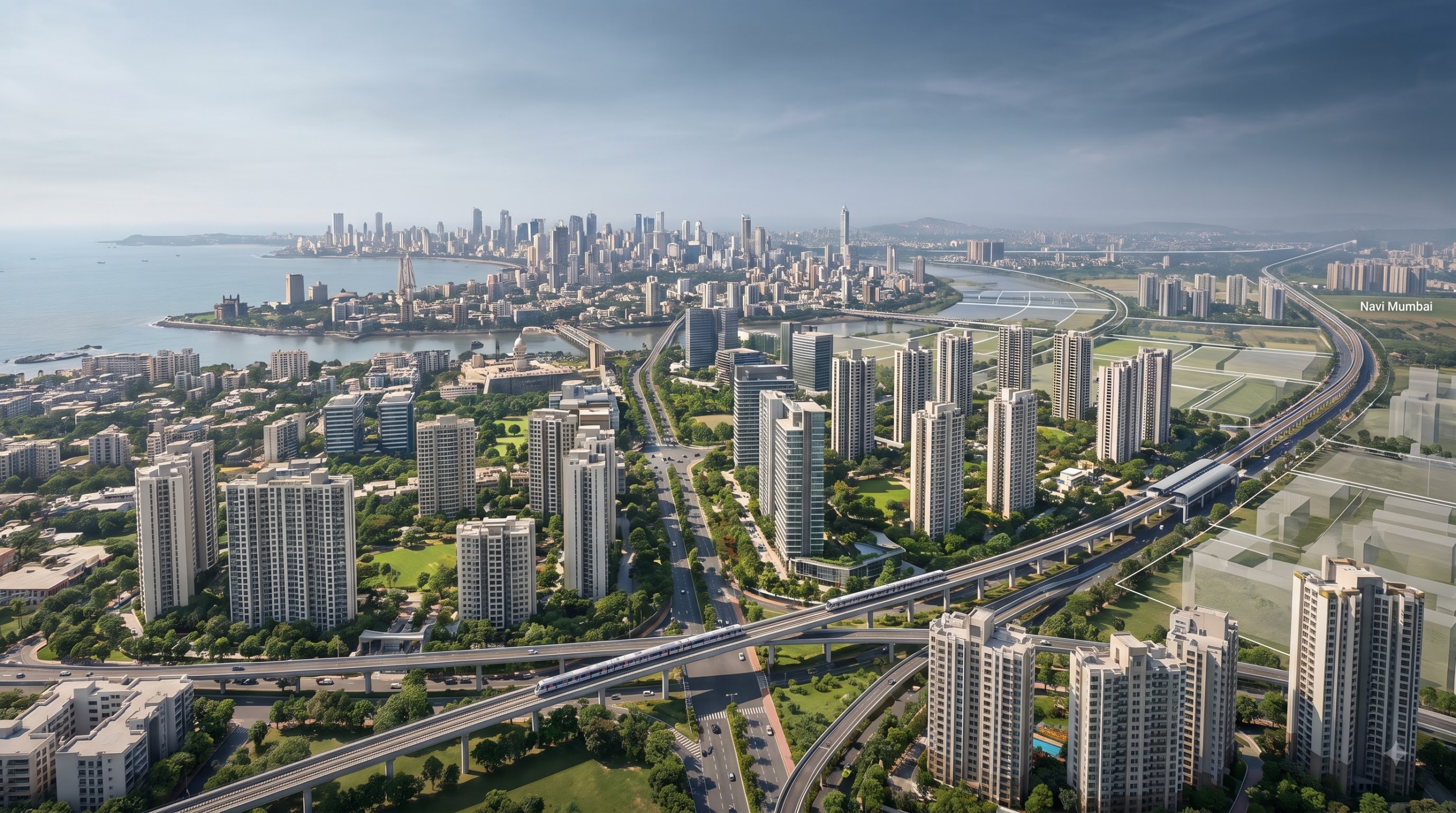
Mumbai 3.0: What the MMRDA–Surbana Jurong Master Plan Could Mean for MMR Real Estate
A Singapore consultancy has been appointed to design India’s newest greenfield city, on the far side of the Mumbai Trans Harbour Link. Here’s what’s confirmed, what’s still speculation, and what it means for the region’s property market.
For most of its modern history, Mumbai has grown the only way an island city can: upward and inward. Old mill land became office towers, suburban paddy fields became apartment blocks, and every new metro line simply intensified demand on land that was already built out. That model is reaching its limits. Mumbai’s next chapter of growth is being written less in floor-space index and more in bridges, airports, tunnels — and, increasingly, in entirely new towns built from scratch on the region’s edges.
That is the context in which “Mumbai 3.0” has entered the conversation. It is a name that sounds like a slogan, but behind it sits a real, notified, government-backed urban development — one that has just taken a concrete step forward with the appointment of a Singapore-based planning consultancy. The question worth asking is not just what is Mumbai 3.0, but what it signals about how, where, and for whom Mumbai real estate will expand over the next two decades.
This piece separates what has actually been confirmed from what is still speculative, and looks specifically at what the development could mean for homebuyers, investors and the broader Mumbai Metropolitan Region (MMR) property market.
What Mumbai 3.0 Is — And What It Isn’t
“Mumbai 3.0” is often described loosely in the press as an MMR-wide master plan, which slightly overstates its scope. Here’s how the four terms actually relate:
The island city and its suburbs — what most people mean when they say “Mumbai.”
CIDCO’s planned satellite city across the harbour, often informally called “Mumbai 2.0.”
The full metropolitan region coordinated by MMRDA — Mumbai, Navi Mumbai, Thane, Kalyan-Dombivli, Panvel, Vasai-Virar and more.
A specific, notified greenfield city — the Karnala-Sai-Chirner (KSC) New Town — not a plan for all of MMR.
Formally, Mumbai 3.0 is the Karnala-Sai-Chirner (KSC) New Town: approximately 323.44 sq km across 124 villages in the Panvel, Uran and Pen talukas of Raigad district. The Maharashtra government notified this area under the MRTP Act on October 15, 2024, appointing MMRDA as the New Town Development Authority (NTDA) for the region.
In short: Mumbai 3.0 is a proposed third city — roughly the size of Navi Mumbai — being planned near the Mumbai Trans Harbour Link (Atal Setu) and the Navi Mumbai International Airport (NMIA), not a redevelopment plan for existing Mumbai neighbourhoods.
Why does a new-town master plan matter to a market where most transactions still happen in existing buildings? Because greenfield plans set the template — road widths, plot sizes, land use zones, green cover, transit corridors — for how a region develops for decades. Get it right, and you get a Navi Mumbai. Get it wrong, and you get uncoordinated sprawl.
Why MMRDA Appointed Surbana Jurong
On August 7, 2026, MMRDA signed a formal agreement with Surbana Jurong Infrastructure Pte Ltd, a Singapore-headquartered urban and infrastructure consultancy, to prepare the Vision Document, Master Plan and planning framework for Mumbai 3.0. The agreement was signed by MMRDA Metropolitan Commissioner Dr Sanjay Mukherjee and Avinash Mishra, Chief Executive, South Asia, for Surbana Jurong, in the presence of Maharashtra Chief Minister Devendra Fadnavis.
Maharashtra government notifies the KSC New Town area under the MRTP Act; MMRDA appointed New Town Development Authority.
MMRDA and Surbana Jurong sign an MoU at the World Economic Forum, covering master planning, architecture, infrastructure engineering and transaction advisory.
Maharashtra government clears Surbana Jurong’s appointment on a government-to-government basis; Phase I work order (~₹11.89 crore) approved, Phase II (~₹23.12 crore) approved in-principle.
MMRDA and Surbana Jurong formally sign the agreement to prepare the Vision Document and Master Plan.
Who is Surbana Jurong?
A Singapore government-linked consultancy, majority owned by Temasek Holdings and CapitaLand, formed in 2015 through the merger of Surbana International Consultants (the corporatised planning arm of Singapore’s Housing and Development Board) and Jurong International Holdings, an industrial-township specialist. The firm has master-planned projects in more than two dozen countries, including Kigali in Rwanda and, closer to home, Amaravati, the new capital of Andhra Pradesh. It is also currently engaged on Telangana’s “Bharat Future City” project near Hyderabad — giving it recent, comparable Indian new-town experience.
It’s worth being precise about what this appointment does and doesn’t mean: Surbana Jurong is the planning consultant, not a developer, financier or construction contractor. It will produce plans and frameworks; execution stays with MMRDA, the state government, and eventually private developers building within approved zones.
What Could the Master Plan Actually Cover?
The assignment covers an assessment of ground conditions across the 124 villages, an inception report, a draft concept land-use plan, a stakeholder consultation framework, and a final concept plan — with Phase I reportedly targeted for delivery over roughly 30 weeks.
Residential, commercial, industrial and mixed-use allocation across the notified area.
Road networks and transit integration with the Atal Setu and NMIA.
Typologies spanning affordable, mid-income and premium residential clusters.
Business districts and logistics zones, given proximity to JNPT in Uran.
Utilities, drainage, water supply, schools and healthcare.
Renewable energy integration and green public space.
Why the MMR Needs a New Long-Term Vision
- Land scarcity — Mumbai has effectively run out of large, contiguous developable parcels, pushing growth toward slower, costlier redevelopment.
- Population & housing demand — the MMR remains one of the most densely populated urban regions in the world.
- Congestion — commute times across the region remain among the highest in urban India.
- Uneven development — jobs have historically concentrated in South Mumbai, BKC and western-suburb pockets.
- Climate & flooding risk — monsoon flooding remains a planning constraint in low-lying areas.
- A new economic centre — with the MTHL and NMIA largely operational, there’s a clear incentive to plan around them rather than allow unplanned sprawl, as happened in parts of Thane and Kalyan-Dombivli.
The Real Estate Impact
This is the section that matters most for readers evaluating Mumbai 3.0 as a real estate signal — so it’s worth being explicit about the chain being discussed, and its conditionality.
Residential demand
A new, planned city adjacent to an international airport and a sea-link crossing could, over time, support fresh residential demand — particularly from buyers currently priced out of Mumbai and Navi Mumbai.
Commercial real estate
If employment hubs materialise as planned — logistics parks tied to JNPT, an aviation-linked business district near NMIA — commercial and warehousing real estate could see early-mover interest ahead of residential absorption, echoing Navi Mumbai’s own development pattern.
Land values & rental demand
Notified new-town areas typically see land-value movement well ahead of construction, driven by anticipation rather than fundamentals — exactly the phase Mumbai 3.0 is in now. Genuine rental demand is unlikely until there’s real on-ground employment and social infrastructure.
The honest summary: Mumbai 3.0 has the potential to become a meaningful real estate corridor over a 10–20 year horizon, the way Navi Mumbai did. Whether it does depends almost entirely on execution — none of which is guaranteed by a master plan alone.
Which Areas Could Benefit?
Mumbai 3.0 sits within Raigad district, but its effects are likely to be felt unevenly across the wider MMR. The areas below are included because they have a genuine, evidence-based connection to this development or the infrastructure underpinning it — not because they’re simply well-known locations.
Established transit hub and likely commercial/civic anchor of the new town. Residential demand already strong, driven by NMIA proximity.
High expectation already priced in; near-term oversupply risk.
Port town (JNPT) and coastal gateway; landing point of the Atal Setu. Potential logistics and port-linked employment zone.
Industrial land-use conflicts; land acquisition sensitivities.
Semi-rural, agrarian, least developed of the three notified talukas. Long-horizon residential/industrial expansion play.
Longest timeline to infrastructure and social amenities.
Established CIDCO-planned city already absorbing MTHL/NMIA-driven demand; likely to remain the “mature” counterpart to Mumbai 3.0’s greenfield growth.
Prices already reflect much of the airport/bridge narrative.
Beneficiaries of region-wide infrastructure, less so of Mumbai 3.0 specifically.
Risk of conflating regional MMR growth with Mumbai 3.0-specific upside.
Peripheral markets driven by affordability, not this project.
Should not be marketed on the Mumbai 3.0 narrative without caveats.
The clearest, most direct beneficiaries on paper are Panvel, Uran and Pen — literally inside the notified boundary — followed by Navi Mumbai, given functional adjacency. Buyers should be cautious of developers invoking “Mumbai 3.0” to justify pricing in areas with no direct planning connection to the KSC New Town.
Mumbai 3.0 and Infrastructure — What’s Actually Connected
It’s worth separating infrastructure that is part of the master-plan exercise from infrastructure that already exists and simply complements it.
Already Operational — Complementary
- Atal Setu (MTHL) — India’s longest sea bridge, operational since January 2024, cutting Sewri–Chirle travel to ~20 minutes. The reason the KSC New Town’s location was chosen — not itself part of the mandate.
- Navi Mumbai International Airport — domestic ops since December 2025, international from May 2026, moving toward round-the-clock operations. Sits within a ~25km radius of the KSC area.
Directly Tied to the Master Plan
- Internal road, drainage, water and utility networks to be defined by the forthcoming plan.
- Land pooling & compensation infrastructure — a March 2026 GR offering landowners FSI, TDR, or 22.5% of developed land back, modelled on CIDCO’s Navi Mumbai approach.
What Could Happen to Property Prices?
This is the question every reader ultimately wants answered — and the honest answer has three time horizons.
Sentiment-driven interest around milestones like this appointment. Plans and MoUs don’t build roads or generate jobs on their own.
If land acquisition proceeds smoothly and the ₹4,000 crore already budgeted translates into visible works — roads, utilities, drainage — genuine value creation could begin.
Sustainable appreciation depends on whether the area actually develops as an employment centre that draws population, not just investor capital.
Why master plans don’t guarantee appreciation
- Land acquisition delays — local opposition over displacement and compensation has already been reported.
- Execution slippage beyond initial estimates — common for large-scale Indian urban projects.
- Regulatory bottlenecks as zoning and development-control regulations are finalised.
- Oversupply risk if speculative buying outpaces genuine end-user and employer demand.
- Affordability constraints if pricing runs ahead of regional income growth.
Mumbai 3.0: Homebuyer vs Investor
For Homebuyers
- Buying purely on a future master plan — before zoning and construction are visible — carries meaningful risk. A plan is a direction, not a delivery date.
- Weigh current livability heavily: existing road access, water supply, schools, healthcare, realistic commute times today.
- Verify the specific plot’s location against the notified boundary — check official notifications, not marketing claims.
- Established markets like Navi Mumbai or Panvel may offer a more predictable near-term living experience than land deep inside a still-forming town.
For Investors
- Track concrete milestones: master-plan completion, zoning finalisation, land-acquisition progress, first infrastructure spending tranches.
- A sensible horizon is long — Navi Mumbai took decades to mature from CIDCO’s original plans into today’s city.
- Early speculative land purchases carry the highest risk-reward profile, and the highest exposure to acquisition disputes and unclear titles.
- Track institutional commitments as a confidence signal, but independently verify claimed valuations and terms.
DHC Realty Market Perspective
The significance of Mumbai 3.0 may not lie in the Surbana Jurong appointment itself, but in how effectively that planning exercise translates into finalised zoning, funded infrastructure, and genuine employment generation over the next several years.
The precedent worth studying is Navi Mumbai — not because Mumbai 3.0 will necessarily replicate it, but because it’s the region’s clearest example of a state-backed authority building a self-sustaining city from a master plan, through slow absorption followed by rapid appreciation once infrastructure and employment genuinely arrived. The land-pooling model reportedly proposed here — developed land or TDR rather than only cash acquisition — is explicitly modelled on that CIDCO experience.
What’s different this time is the starting infrastructure base: unlike Navi Mumbai in its early decades, the KSC New Town area already sits beside a functioning sea-link and a commissioning international airport. That’s a materially stronger starting position — but it’s also why land-price expectations may already be running ahead of the master plan’s actual completion.
Indicators to watch, 2026–2031
- Master plan finalisation — actual zoning maps, not just conceptual documents.
- Land acquisition progress — consent rates across the 124 villages.
- First infrastructure works funded from the ₹4,000 crore already budgeted.
- Employment-linked announcements tied specifically to the notified area.
- Residential launch activity — formal project launches, not just land banking.
What Should Property Buyers Watch?
- Official master plan release and finalised zoning
- Actual land acquisition / pooling progress and consent rates
- Confirmed road and utility infrastructure completion
- Metro or rail connectivity plans specific to the corridor
- Verified employment or industrial commitments tied to the area
- Social infrastructure — schools, hospitals — planned or delivered
- Rental demand data as a real-economy signal, distinct from land speculation
- New residential supply entering the market and its pace vs demand
- Developer track record for any project launching in the corridor
- RERA registration and government approvals for any specific project
- Current, verified prices rather than informally quoted asking rates
- Realistic timelines, benchmarked against past Indian new-town delivery
Mumbai 3.0: Opportunity or Hype?
Both — depending on the time frame and the specific claim being evaluated.
As a long-term urban-planning exercise, Mumbai 3.0 is genuine and government-backed, with real infrastructure (the Atal Setu and NMIA) already in place around it — a materially stronger starting point than most Indian greenfield city projects have had. The appointment of an internationally experienced consultancy, following a formal MoU and government approval process, suggests this is being treated as a serious institutional undertaking.
As an immediate investment thesis, it’s too early to draw firm conclusions. The master plan hasn’t been finalised or publicly released in detail; land acquisition across 124 villages is ongoing; and history shows Indian new-town projects — including, at times, Navi Mumbai itself — have taken far longer than initial timelines suggested.
Master planning creates a framework. Execution — land acquisition, funded infrastructure, real employment — determines whether that framework becomes a functioning city or a slow-moving land bank. The right posture right now is informed patience.
- Mumbai 3.0 is the Karnala-Sai-Chirner New Town — a 323.44 sq km greenfield city in Raigad district, not a master plan for all of MMR.
- MMRDA appointed Surbana Jurong in August 2026 to prepare the Vision Document and Master Plan, following a January 2026 Davos MoU and June 2026 state approval.
- The project’s location near the Atal Setu and NMIA is its biggest structural advantage over earlier Indian new-town attempts.
- Real estate benefits are directly tied to Panvel, Uran and Pen, and to neighbouring Navi Mumbai — not automatically to the wider MMR.
- Land acquisition, master-plan finalisation and funded infrastructure — not the announcement itself — are the milestones that matter.
- Buyers should prioritise current livability and verified location; investors should treat this as a long-horizon, execution-dependent opportunity.
- Historical precedent (Navi Mumbai) shows this kind of project can take decades to mature, even when eventually successful.
Frequently Asked Questions
What is Mumbai 3.0?
Officially the Karnala-Sai-Chirner (KSC) New Town — a proposed greenfield city covering about 323.44 sq km across 124 villages in Panvel, Uran and Pen talukas of Raigad district, notified in October 2024.
Who is preparing the Mumbai 3.0 master plan?
Singapore-based Surbana Jurong Infrastructure Pte Ltd, appointed by MMRDA in August 2026 to prepare the Vision Document, Master Plan and planning framework.
What is MMRDA?
The Mumbai Metropolitan Region Development Authority — the state agency responsible for planning and infrastructure across MMR, also designated New Town Development Authority for Mumbai 3.0.
What is Surbana Jurong?
A Singapore government-linked planning and infrastructure consultancy, majority owned by Temasek Holdings and CapitaLand, with prior work on Amaravati and Telangana’s Bharat Future City.
Is Mumbai 3.0 the same as an MMR-wide master plan?
Not exactly. It’s a specific 323.44 sq km new-town project. Some reports describe a broader “MMR Growth Hub” mandate with KSC New Town as the flagship — but the confirmed scope is the KSC New Town area.
Which areas are part of the notified zone?
Panvel, Uran and Pen talukas of Raigad district, covering 124 villages.
Will Mumbai 3.0 increase property prices?
There’s no guarantee. Near-term movement may be sentiment-driven; sustained appreciation would depend on infrastructure delivery, land-acquisition progress and genuine employment generation over years.
Which areas could benefit from Mumbai 3.0?
Panvel, Uran and Pen most directly, as part of the notified area; Navi Mumbai as a strong indirect beneficiary. Broader MMR markets benefit from regional infrastructure generally, not this project specifically.
Should I invest in MMR because of the master plan?
That depends on individual goals and risk tolerance. The plan is still in preparation and land acquisition is ongoing — treat this as an early-stage, long-horizon opportunity with corresponding risk.
How will Mumbai 3.0 affect homebuyers?
Current livability, verified project location relative to the notified boundary, and realistic timelines matter more than long-term promises.
When could the impact become visible?
Given the current stage, meaningful on-ground impact is a multi-year proposition — likely unfolding over the next 5–10 years and beyond.
Is Mumbai 3.0 connected to the Trans Harbour Link and Navi Mumbai Airport?
Yes, indirectly. The KSC New Town sits within the influence zone of both, and their existence is a key reason the location was chosen — but both are separate, already-operational projects, not components of the master-plan assignment itself.

Join The Discussion