
 by
by
Mumbai’s Property Market Just Hit a 14-Year Record — Here’s What Every Buyer and Investor Must Know in 2026
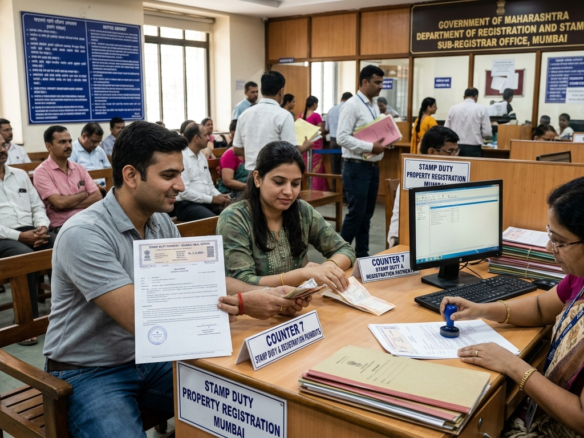
Mumbai recorded 13,029 property registrations in February 2026 — the strongest February performance in 14 years, generating over ₹1,134 crore in stamp duty revenue. This is not a temporary spike. It is a structural signal that Mumbai’s real estate market has entered a new phase of growth — and smart buyers need to act before the window narrows.
Property Registrations · Feb 2026
Stamp Duty Collected
Revenue Growth YoY
Why This Record Matters More Than You Think
Mumbai’s February 2026 property data, published by Knight Frank India, is not just a number — it is a 14-year statement of market confidence. The last time the city saw registrations this strong in February was 2012. Since then, the market has weathered demonetisation, RERA rollouts, GST restructuring, and a global pandemic. What we are seeing now is a market that has come out stronger on the other side.
Equally telling is the gap between registration growth (+8% YoY) and revenue growth (+21% YoY). That gap reveals a premium housing surge — buyers are spending more per transaction. The market has decisively shifted upward.
Registrations Growth YoY
Up from 12,066 units in February 2025, marking the highest February volume in 14 years across BMC jurisdiction.
Share of ₹5 Cr+ Properties
Premium transactions above ₹5 crore rose from 6% to 8% YoY — a clear tilt toward high-value, large-ticket purchases.
Western Suburbs Market Share
The Western Suburbs dominate Mumbai’s housing market in 2026, with Central Suburbs contributing another 30% of registrations.
Sub-1,000 Sq Ft Units
Compact apartments still dominate volume — but this share is declining as buyers upgrade to larger configurations.
“Mumbai’s residential market is not merely witnessing a cyclical upswing — it is demonstrating structural stability, infrastructure-led growth, and long-term confidence.”
— Shishir Baijal, Chairman & MD, Knight Frank India · March 2026
Best Areas to Buy Property in Mumbai in 2026
Demand is not uniform across Mumbai. Micro-markets are performing at different speeds, driven by metro connectivity, redevelopment supply, and proximity to employment hubs. Here is DHC Realty’s current assessment of the top corridors to watch in 2026.
| Area | Price Range | 1-Year Outlook | Best For | Status |
|---|---|---|---|---|
| Worli | ₹40K–55K/sqft | +12–15% | Luxury, sea-facing | 🏆 Hot |
| Bandra / BKC | ₹42K–58K/sqft | +10–14% | Premium residential & commercial | 🏆 Hot |
| Lower Parel | ₹40K–50K/sqft | +10–13% | Professionals, rental yield | ↑ Rising |
| Ghatkopar / Mulund | ₹18K–28K/sqft | +8–11% | Mid-segment families | ↑ Rising |
| Andheri (W) | ₹22K–38K/sqft | +8–12% | Investors, young buyers | 🏆 Hot |
| Kharghar / Panvel | ₹8K–14K/sqft | +6–9% | Long-term appreciation play | ◆ Watch |
What the Premium Shift Means for First-Time Buyers
The decline of the sub-₹1 crore segment from 46% to 40% is one of the most important signals in the February 2026 data. It does not mean affordable housing is disappearing — it means buyers are stretching their budgets because they believe prices will be higher next year. That confidence is well-founded.
If you are a first-time buyer with a budget of ₹1.2 to ₹2.5 crore, the ₹1–2 crore segment is your primary zone — and it just grew from 31% to 33% of all transactions. Demand here is real, competition is increasing, and the window for pre-appreciation entry is narrowing with every passing month.
- The ₹1–2 crore bracket expanded to 33% of all February 2026 registrations — up from 31% in 2025, confirming strong mid-segment absorption.
- Suburban micro-markets like Ghatkopar, Mulund, and Andheri offer entry-level pricing with metro connectivity benefits already priced in.
- Redevelopment projects across the Western Suburbs are introducing larger flat configurations at competitive prices — ideal for upgraders.
- Home loan rates remain stable in 2026, with banks fast-tracking approvals and digital verification reducing transaction friction significantly.
- MahaRERA oversight has strengthened developer accountability — buyers today face far lower project-delivery risk than they did five years ago.
The Investor’s Playbook — 3 Strategies for 2026
Infrastructure-driven appreciation is Mumbai’s most reliable investment thesis — and 2026 is the year that thesis is playing out across multiple corridors simultaneously. Here is how smart investors are positioning themselves.
Short-Term Play (0–12 Months): Premium Micro-Markets
Worli, Bandra, and BKC are experiencing the sharpest demand at the top end. Properties priced above ₹5 crore now represent 8% of all transactions — and that number is growing. Limited resale churn and strong NRI demand make this segment resilient. Entry now, before mid-2026 price resets, positions you at the bottom of the next appreciation curve.
Mid-Term Play (12–30 Months): Infrastructure Corridors
Ghatkopar–Mulund and the Andheri East–SEEPZ corridor are the standout mid-term opportunities. Metro Line 3 integration, the Atal Setu / MTHL effect on Navi Mumbai, and the upcoming Navi Mumbai International Airport are all creating 18–36 month appreciation cycles in adjacent residential zones.
Rental Yield Play: Lower Parel & Mahalaxmi
Lower Parel continues to deliver 4% rental yields backed by rising corporate housing demand. With Metro Line 3 now operational and Coastal Road easing westward mobility, Parel and Mahalaxmi have entered a strong rental cycle. For buy-to-let investors, these neighbourhoods offer a difficult-to-beat risk-reward profile in 2026.
Frequently Asked Questions
Ready to Buy in Mumbai’s Record Market?
Mumbai just recorded its strongest February since 2012. Our team helps you identify the right property at the right price — before this window closes. Free consultation. No obligation. RERA-registered.
✓ RERA Registered
✓ 15+ Years Expertise
✓ Reply Within 2 Hours
Join The Discussion